Sunday, 24 May 2015

Glimpses of Spirit

This Pentecost Sunday, when we celebrate the gift of the Holy Spirit coming to the church, I want to share with you a flavour of the last week at the General Assembly of the Church of Scotland - and the places I've been encouraged in seeing the breath of the Spirit still blowing through the church.
We read this morning;
Romans 8:24-26
For in hope we were saved. Now hope that is seen is not hope. For who hopes for what is seen? But if we hope for what we do not see, we wait for it with patience.
Likewise the Spirit helps us in our weakness; for we do not know how to pray as we ought, but that very Spirit intercedes with sighs too deep for words.
Celebrating, today, the gift of God's Holy Spirit, we celebrate hope. The hope that all those things we can barely express, all the things we tie ourselves in knots about are safe with God and that, when we run out of words or inspiration, when we run out of steam, God is there and God's Spirit is still at work in spite of our inability to find a way through.
We know that all things work together for good for those who love God, who are called according to God's purpose

For the past three years now I have had the privilege of attending the General Assembly as chaplain to the Youth Delegates.
Each Presbytery is invited to send one youth delegate and a further 10 delegates are nominated by the National Youth Assembly.
Sadly, not all Presbyteries are able to find a young person aged between 18 and 25 who is willing or able to serve in this capacity.
But the young folk that attend, all with different experiences and impressions of the Church of Scotland bring with them uniqueness and vitality.
Although we do our best to explain to them how varied and intense the week will be, it's pretty indescribable.
But they always not only rise to the challenge but embrace all that is thrown at them.
We gather on the Friday night before GA starts, so that we can eat together, have an orientation session in the Assembly hall and introduce ourselves.
Once we've done all that, it's back to the conference room at the hotel (we all stay together) to start prepping for the debates coming up the next day.
That's something we do each evening after dinner - prepare for the next day.
We go through the reports with delegates, we answer their questions if we can and we help them formulate any questions they might like to ask the Convenors who present reports or any comments or deliverances they might want to make.
Over the years, the Assembly has come to realise how well prepared the young people are, often better prepared than Commissioners, and their contributions are received with respect.
Some of the Youth Delegates are very articulate, some are extremely nervous and hesitant, but, with courage, they make their points and affect the decisions of the Assembly.  
We conclude each evening with worship led by the staff team.
Next morning, we gather by 8:15 for worship, led by the Young People before we make our way to the Assembly Hall.
The first day is full of ceremony.
It's quite a spectacle with bands and buglers.
Some of the spectacle is repeated each morning, as the Lord High Commissioner. The Queen's Representative arrives but it's not quite the show that it is on the Saturday in the opening ceremony.
As the Very Rev. John Chalmers handed over the reins, he remarked on how one of the things his year as Moderator had proved to him was what a high profile the church plays in civic life.
In spite of the stories of decline we hear, the church as an institution still has an important role and function in Scotland,the UK and beyond.
However, this isn't the time for the Moderator to reflect on his or her term of office - that happens on the Saturday night.
This ceremony is about handing over the role to the Moderator Elect, this year, Right Reverend Angus Morrison, who immediately takes up office and assumes responsibility.
On the Saturday evening, the outgoing Moderator addresses the Assembly and reflects on his or her term of office.
There is also a welcome for overseas Delegates on the Saturday night.
Do you remember the doves we wrote messages on in one service - some of those were in the Assembly Hall on Saturday night.
Many representatives are invited from lots of different countries and denominations.
They play a full part in proceedings, contributing to debate and bringing stories of the health of the church where they are.
Many of these delegates consider the Church of Scotland to be their mother church, responsible for bringing them faith.
This year, I was asked by some of the RevGals I've met to look out for Ken Kovacs who was the delegate from the PCUSA.
On Sunday morning, a service for GA is held in St Giles. It's always fun to attend with Youth Delegates because it's vastly different from their experience of worship but most seem to really appreciate the opportunity to be part of something so formal.
After Lunch together, we become involved with Heart and Soul - an event that takes place in Princes Street Gardens. We all tend to be involved helping out in different ways.
This year, I was involved in the Spill the Beans tent, introducing people to the worship resource that we use here. We shared with them the Psalms material that we'll be using in the summer.
We encouraged folk to take part.
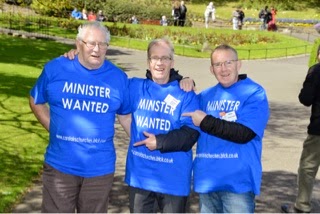
Some folk saw the opportunity to advertise their vacancy at Heart and Soul-  I was waylaid with a number of Parish Profiles.
Over 6000 people took part in Heart and Soul, despite the threat of rain, although it stayed fine throughout the afternoon and the closing worship was amazing with all these folk gathered in the shadow of Edinburgh Castle.
Monday morning sees the Assembly celebrating Communion together, something many of the Youth Delegates are keen to be involved in. As you might imagine, it is some feat to organise communion for that many people in such a big venue.
The singing is always amazing.
This year, there were a few hearing challenged delegates.
One in particular, Mary, had a hearing dog, Scott. (We recently heard about hearing dogs at the Guild)
It was very moving to see all that happened at Assembly, being signed. And, throughout the week, there was a large team of interpreters involved.
Assembly is always accompanied by Fringe Events on all manner of things.
Inclusive worship, prayer meetings, seminars and receptions.
The Youth Delegates were quick to learn that it is possible to secure a free lunch every day by attending one of the Fringe Events.
During the day, folk meet up for coffee and enjoy fellowship and short breaks from the intensity of business. Or to do some book promotion.
Just one of the more inspiring speeches at Assembly came from a local delegate, Isabell Montgomerie from Ochiltree who encouraged elders present to find ways to show their minister how much they were appreciated. Isabell was involved in a special commission that took her around the country interviewing ministers and was disturbed to find that many ministers felt they were working under stressful conditions with little appreciation.
In fact, her speech was recorded and can now be found on You tube.
Each day is filled with reports and debates on the life and work of the Church of Scotland.
One of those reports honours the work of Military Chaplains.
It's always an impressive sight to see the Assembly hall filled with folk in uniform.
And the Moderator hosts a special reception for them.
A highlight for the Young people is the opportunity to report on the National Youth Assembly.
The national Youth Assembly elects a Moderator each year and, this year, it was Rachel Hutcheson from Inverness. Rachel has just completed her training as a primary school teacher and was an able moderator.
She reported on the National Youth Assembly, held last August, with the theme "In my Fathers House." 
During her year in office, Rachel was involved with the GA Moderator in a number of events, including the Christian Aid Munro Challenge which raised a phenomenal amount of money for Christian Aid's work in Nepal.
The next moderator of the NYA will be Hannah Mary Goodlad, a geologist from Shetland who works for an oil company and who is very concerned with sourcing renewable energies.
The Youth Delegates are invited to the Beating of the Retreat and a Reception at Holyrood Palace.
This is an opportunity for them to dress up and enjoy the hospitality provided.
They are so good at looking out for each other that even those who feel awkward in such social events manage to have fun and not feel left out.
On the last day, the Assembly deals with any remaining business before embarking on the Closing Ceremony.
I had never attended the closing ceremony before I became chaplain to the Youth Delegates, always choosing to head home at lunchtime on the Friday.
But it really is quite a ceremony.
Those ministers who have died in the last year are remembered, each name read, new ministers are welcomed as well as new staff and Convenors of Councils.
The Lord High commissioner then addresses the Assembly, telling of the duties he has undertaken during the week, before the clapping out ceremony when  everyone gathers in the quad to clap out the Lord High Commissioner, the Moderator and all the Assembly Officials. A weird but lovely tradition.
You may have noticed that I haven' t mentioned the issue that you probably read about or heard about on the news this week - that of ministers in same sex partnerships being able to be ordained and hold office. There were just as many opinions in the ranks of the Youth Delegates as there were with other  Commissioners. But all agreed that the church has many other issues to debate, not least the gospel we are called to proclaim.
Spending time with so many committed and enthusiastic Youth Delegates gives me great hope for the future of the Church of Scotland at home and abroad.
We give thanks for the hope we have and for the freedom to live out the gospel in the power of the Holy Spirit.
Thanks be to God. 

*Some images shared from the Church of Scotland Facebook Page*

Sunday, 10 May 2015

Living in hope


Romans 5:1-11
Results of Justification
​Therefore, since we are justified by faith, we have peace with God through our Lord Jesus Christ, through whom we have obtained access to this grace in which we stand; and we boast in our hope of sharing the glory of God. And not only that, but we also boast in our sufferings, knowing that suffering produces endurance, and endurance produces character, and character produces hope, and hope does not disappoint us, because God’s love has been poured into our hearts through the Holy Spirit that has been given to us.
For while we were still weak, at the right time Christ died for the ungodly. Indeed, rarely will anyone die for a righteous person—though perhaps for a good person someone might actually dare to die. But God proves his love for us in that while we still were sinners Christ died for us. Much more surely then, now that we have been justified by his blood, will we be saved through him from the wrath of God. For if while we were enemies, we were reconciled to God through the death of his Son, much more surely, having been reconciled, will we be saved by his life. But more than that, we even boast in God through our Lord Jesus Christ, through whom we have now received reconciliation.

In the Name of the Father, the Son and the Holy Spirit

I didn't intend to - but once the Polls closed on Thursday night, I found myself sitting in front of the Television, just to see the first few results declared.
But the first few Scottish results were so surprising that, I decided to wait for a few more and, before I knew it, it was 4am.
Knowing that Friday was going to be a busy day, I forced myself to go to bed. 
It was an amazing night in Scottish politics.
A night in which it was so easy to be swept up in the joy  - or despair - of politicians and electorate alike. 
While I was watching the results come in on TV, I was also monitoring my Facebook feed (I'm a woman, I'm good at multi-tasking!) and it was fun to see all the different comments and reactions, liberally peppered with the usual Scottish black humour.
Indeed, over the weekend there have been a huge number of jokes made about the changed face of Scottish and UK politics - that's just how we Scots cope with change and uncertainty:
When I posted on Facebook, yesterday  that I was visiting the Kelpies, a friend, quick as a flash, commented that there were more Kelpies in Scotland than there were Labour MPs.

But, after my late night/early morning on Thursday into Friday, in the cold light of day, I was reflecting on what the massive political change might mean, not just for Scotland but for the whole of the UK.
And one of the first things that struck me was how, in just a few hours, life had changed dramatically for lots of people - not least those MPs who had worked tirelessly for the constituencies they served and who, at any other time, might reasonably have expected to remain in place, but, this week, lost their jobs and all that goes with that.
I went to bed in the wee small hours on Friday, thinking that history had been made in Scotland.
But, waking up a few hours later, I began to realise what a fragile place it is to be - at the beginning of a new era, where the landscape seems to have shifted, where there is more uncertainty than anything else.
And where, above all, there is a lot of hard work to be done before we can forge the way ahead.
It's a tall order to fulfil all the promises made in the run up to the election.
And that work requires everyone.
It requires the elated, the devastated, the indifferent.
It needs all of us to be involved in shaping the future.
Delivering promises calls for courage and compassion, for patience and persistence, and, above all, for hope.
Hope that, together, we can create societies that care for the poor and vulnerable.
Hope that, together, we can deliver on the stuff that makes up manifestos and election promises.
Hope that, together, folk will work across party lines to make a difference in communities divided.
So, on this post election Sunday, I want to ask:
What gives you hope?

Last week, we looked at Paul's introduction to his letter to the Romans.
We noticed how he set out his stall.
He declared his credentials as a follower of Christ.
Paul had to do that because he was known to many as a persecutor of Christians.
So he had to work hard to convince people he had changed.
And I'm sure his words weren't enough.
I'm sure folk were waiting to see if his words tied up with his actions.
A bit like we are doing in this post election time.
Waiting to see if people can change.
Waiting to see if promises will be fulfilled.
If the actions match up to the words, the many words that have been spoken in the last wee while.
Right now, we are living in hope.

Our reading this morning speaks of hope - we read:
Therefore, since we are justified by faith, we have peace with God through our Lord Jesus Christ, through whom we have obtained access to this grace in which we stand; and we boast in our hope of sharing the glory of God. And not only that, but we also boast in our sufferings, knowing that suffering produces endurance, and endurance produces character, and character produces hope, and hope does not disappoint us, because God’s love has been poured into our hearts through the Holy Spirit that has been given to us.

What gives us hope?
Paul, in his letter to the Romans, describes hope as something in which we can boast, something that does not disappoint.
There will always be pedlars of false hope, hope that is not realistic and cannot be sustained in the face of adversity.
The kind of hope of which Paul speaks, however, arises out of adversity.
The kind of hope of which Paul speaks is a response to suffering, a radical response that consists not in our gritting our teeth and willing all things to be well but in our enduring hardship in the faith that suffering will not have the last word.
The hope that, at the end of all things, God is.
I was intrigued to find a statement about hope from Vaclav Havel, former president of Czechoslovakia and the Czech Republic.
Havel was frequently imprisoned as he fought against the effects of Communism.
But here is what he said about hope;
"Hope is a state of mind, not of the world. Either we have hope or we don't; it is a dimension of the soul, and it's not essentially dependent on some particular observation of the world or estimate of the situation. ..(Hope)is an orientation of the spirit, and orientation of the heart; it transcends the world that is immediately experienced, and is anchored somewhere beyond its horizons ...Hope, in this deep and powerful sense, is not the same as joy that things are going well, or willingness to invest in enterprises that are obviously heading for success, but rather an ability to work for something because it is good, not just because it stands a chance to succeed... Hope is definitely not the same thing as optimism. It is not the conviction that something will turn out well, but the certainty that something makes sense, regardless of how it turns out."
Vaclav Havel Disturbing the Peace

Isn't that the kind of hope that we need today?
People of all political persuasions have to be convinced to work together to create just communities, no matter how unlikely to succeed that task might seem. 
Because it is right. 
Because it makes sense.
That is hope.
And, however optimistic or pessimistic we are feeling in this changed political landscape, hope drives us to work together to build robust communities with care and compassion.
Communities where all know that they are valued, where all feel that their contribution matters, where strangers are welcomed and the poor and the vulnerable are not just cared for but enabled to break free from all that keeps them imprisoned.
Our task, our calling is to work toward those goals not because we are sure of success but because we know that it is the right thing to do.
That is hope.


It is well documented that when humans can summon hope, life takes on meaning and purpose.
Just as there is something life giving in the human ability to dredge up hope in every circumstance, however bleak, the hope of obtaining the gift of being reconciled to God is also life giving and life enhancing.
Paul, throughout his letter to the Romans stresses this point again and again, especially in Romans 8, when he reminds us that absolutely nothing can separate us from the love of God which is ours in Christ Jesus our Lord. 
All of life takes its meaning from the underpinning love of God.
Hope in that gift of love cannot fail to make a difference whatever else happens in life.
And so we ask ourselves again this morning, in the light of all the changes wrought this week:
What gives us hope?

Let me share with you a reflection, written long before I knew that, on this post-election Sunday, I'd be preaching on Paul's message of hope:

For what do you hope?
Is it some future event?
Something that can be planned, researched, engineered or financed?
Like a cure for cancer?
Or a way of regenerating brain cells destroyed in dementia?
Or marvellous DNA repairs for confused chromosomes?
For what do you hope?
Is it some notion that tomorrow will be better?
That the benefits system will serve those in need?
Or that Food Banks will no longer be necessary?
That no one will sleep rough on our streets but that all will know shelter?
For what do you hope?
Is it for signs of world peace?
The dismantling of refugee camps?
The sharing of clean water?
For what do you hope?
The promise of God
for God’s people everywhere
is to know peace in every situation
because we are loved by the God whose name is love
and who, in Christ has already gathered us up in love.
Now that is something for which to hope.
And a hope that will not disappoint.

Thanks be to God.

Sunday, 12 April 2015

Still risen!


Matthew 28:16-20
The Commissioning of the Disciples
Now the eleven disciples went to Galilee, to the mountain to which Jesus had directed them. When they saw him, they worshiped him; but some doubted. And Jesus came and said to them, “All authority in heaven and on earth has been given to me. Go therefore and make disciples of all nations, baptising them in the name of the Father and of the Son and of the Holy Spirit, and teaching them to obey everything that I have commanded you. And remember, I am with you always, to the end of the age.”

In the name of the Father,the Son and the Holy Spirit. Amen

For the last few weeks we've been preparing ourselves for Easter.
Throughout Lent -  in our daily reflections, in our midweek services and in our weekly study groups.
Through Holy Week -  following Jesus journey toward the cross, gathering with the disciples in the upper room and, on Good Friday, watching the shadows lengthen as we reflected on Jesus death.
And then, last Sunday, Easter Day, we reclaimed the Alleluias and celebrated Jesus' resurrection.
We crept to the tomb with the women, spices in hand, and rejoiced to see the stone rolled away.
And we discovered that Jesus was no longer in the tomb but was going, ahead of his disciples, to Galilee.
Already ahead of us.
At large in the world today.
So that was last Sunday.
High energy after our measured pace through Lent.
An exhausting pinnacle of faith.
So,what's next?
Now that we've had a week to recover,what now?
Last week, we read of the women being told by the angel at the tomb to hurry and tell the disciples that Jesus had risen.
They went with great fear and joy.
As they rushed off to do as the angel said, Jesus met the women in the garden and he told them to tell the disciples to go to Galilee where he would meet them.
And this week's reading, tells of that reunion in Galilee.
Clearly the women did as Jesus told them - they spread the news and the disciples followed the Risen Christ to Galilee.
They met Jesus on the mountain.
And, we're told, the disciples worshiped Jesus - but some doubted.
It was a time for mixed emotions.
The women leave the garden, witnesses to the resurrection, in fear and joy.
The disciples meet Jesus in Galilee, on the mountain top and worship him - but some doubted.
Mixed emotions everywhere.
But Jesus commissions them all the same - to go and make disciples.
Jesus, having been betrayed, denied, abandoned by these same disciples, some of whom still doubt, yet commissions them to go and make disciples of all nations.
That has to be good news for us.
Good news and scary news.
Our doubts do not prevent us being commissioned by Jesus to go and make disciples.
Jesus, knowing that we too will betray him, deny him, doubt him, entrusts us with sharing the good news today.
Entrusts us to go and make disciples in our everyday.
And that is the what now of Easter.
It's moving from the tomb, leaving the sanctuary, knowing that Jesus has gone ahead of us into our everyday - and waits on us to take up his commission to make disciples.
How?
By living as Resurrection people.
By living as people who know that love is stronger than death.
By sharing that love in our everyday, with family, with friends, with neighbours and colleagues.
Even when we doubt.
And, in our sharing, being open enough to see that God continues to reveal Jesus risen among us - in the unlikeliest places.
It never fails to amaze - and to humble me - how often, when I think I'm faithfully sharing the gospel, that God reveals something new - those I imagine I'm teaching, or to whom I'm witnessing become my teachers in the lessons of God.
Perhaps that's just a part of Jesus command to " go to all nations". To do so requires an openness, openness, not just to what we have to share but to what we can learn from others.
I recently shared a story of my time working in shipyard chaplaincy.
(In fact it's a story included in a book that was released this week: There's a Woman in the Pulpit- stories from women in ministry in different parts of the world)
The point of the story is not to tell of my faithfulness in sharing the gospel in an inhospitable Lower Clyde shipyard, but to share how much I learned from the platers, the caulkers, the burners and the carpenters with whom I huddled round a brazier fire of a morning, drinking tea from filthy mugs.
On a couple of occasions, I got to bless a ship before she was launched - and this was what I wrote about the experience:
"And so, another liturgy was written on the hoof, informed by the need to minimise the time the ship waited on the well greased stocks, and another ministry of privilege was exercised and all manner of things was taught to a fledgling chaplain by men with calloused hands and choice phrases and hearts of gold all wrapped up in wisdom and grace."

That great Commission, to go to all nations and make disciples, is not simply about us taking what we have and passing it on to others.
It is about us being open to all the facets of the gospel that God reveals to us in others, even and especially, those to whom we think we are called to  minister.
Christ continues to go ahead of us and to meet us on the way, asking us to be open to his risen presence in all whom we encounter.

Easter is not the end of the journey.
It is just the beginning.
And, even in our weariness, even with our doubts, the Risen Christ entrusts us with being and with making disciples.
And that's the work, not of a moment, but of a lifetime.
Here is a reflection I wrote last Easter about the lasting effects of the Resurrection:

It trickles in slowly
Just like the soft light of dawn
It's not the sudden trumpet fanfare
that we have made it
but a slow, gentle unfurling.
As Easter creeps forward
its touch slowly awakening
all in its path
the effect is gradual
measured
long lasting.
Even when the dawn of Easter
startles
provoking excitement
it is the calm that is left in its wake
that remains
the warmth and the joy
that continue to infuse
and change lives.
And it is the soft memory
of eternal promises
that persists
even when night has come again.
Easter - not an all at once
life changing moment
But a slowly dawning
gift for eternity
a treasure
with layers
upon layers 
of wrapping
to be gently unveiled
and savoured
in the fullness of time.

Christ is still risen.
He is risen indeed.
Alleluia!

Monday, 23 March 2015

Palms and Passion

Some reflective resources for Palm Sunday

Hold on to the Hosannas

Let’s stay with the Hosannas for a while
Let’s let them keep on ringing in our ears
Hosanna!
Blessed is He who comes in the name of the Lord
Instead of rushing on to hear the cries
that came later in the week
Let’s stay with the Hosannas
Maybe once we’ve heard those
in a new way
will we be ready
to make the rest of the journey
A journey that was hastened
and given new purpose
by those Hosannas
For those Hosannas were not
simply the innocent cries
of palm branch waving children
Those Hosannas were the war cries of adults
tired of the oppression
of occupying forces
Those hosannas
were the hopeful cries
of a nation seeking liberation.
Those Hosannas
were an investment of hope
in one they thought would deliver.
Those Hosannas
that we have sanitised  over the years
rang out in clear insurrection
sealing the fate
of one who rode on a donkey.
so, let’s stay with the Hosannas
Let’s wrest them from the lips of children
and allow them to ring in our ears
and spew from our mouths
as a call to action
a call to justice
a call to love.
Let’s stay with the Hosannas
even as we journey
with the Christ
who carried those Hosannas
all the way to the cross
and ensured their fulfilment
as the justice and love of God.
Let’s stay with the Hosannas.

The weeks have rolled on
those austere, bleak weeks
of our Lenten observance.
We’ve journeyed with Jesus through the wilderness
felt the rub of sand on our feet as we traversed the desert
and again, as we emerged with him on the shore at Galilee.
We’ve marvelled at the things he did
and cringed at the things he said
one moment proud to step out beside him
the next, embarrassed to know him.
He’s been wild, free, tormented and cursed
sometimes all at the same time.
Oh we’ve had laughs,
laughs that burst our guts as he burst the disciples’ nets,
We’ve had our party times with him too,
even through this season of penance
How could we not party when we saw him eating, drinking,
making merry?
So often there was a lightness in his step
a freshness that lifted us up
We’ve listened to his stories, marvelled at his miracles
Questioned our living
in the light of the way he showed us
And that’s all to the good.
But sometimes he got a bit heavy,
nudged us out of our comfort zones
challenged us to respond to his words
and not just passively listen,
goaded us to be different –
For the sake of the kingdom he said.
What kingdom is the question.
He’s said some tough things,
upset a lot of people
He’ll be lucky to survive with his life
never mind build a kingdom.
There’s definitely a change in the atmosphere now.
All the talk recently has been bizarre
Of death and darkness and destruction
But also talk of hope and newness.
The two simply don’t go together.
Still, the mood is changing
It looks like we’re going to have the party of all parties
And then, who knows?


Becoming like children
We imagine Jesus riding into Jerusalem
surrounded by palm branch waving children
surrounded by exuberance
and infectious laughter
shouts of greeting
cajoling and cheering.
There is a freshness in the welcome of children
a candour that is not subdued
or diminished
but comes from the heart.
bringing warmth, promoting acceptance
with is no expectation of return
but simply a desire
to spread the love.
We imagine those greetings containing familiarity
arising not out of disrespect
but out of the ability
to naturally honour and cherish
every relationship
deeming all as worthy of nurture
and investment.
We imagine Jesus surrounded by children.
The adults would have been much too reserved,
too inhibited
to be so vulgar
in their welcome.
Palm branch waving
and jacket tossing
are not for sophisticated grown ups.
We leave that nonsense to the children.
And most of the time that’s OK.
Most of the time, we are quite relieved
to keep our feelings to ourselves
to remain tight lipped
cool and distant.
But, on occasion,
wouldn’t it be great
just to throw caution to the wind
and let our exuberance escape
even just for a little while?
And what better day than this fools day
when we celebrate the absurdity
of a king riding a donkey
into Jerusalem.
Palm Sunday – a day to become like children.

What of the children

What of those children lining the streets.
Caught up in the adults’ excitement.
A festival or feast day for them.
A family day out.
With a special picnic.
For once they could be noisy in the presence of adults.
Because the adults were being noisy too.
For once they weren’t being told to simmer down.
They’d probably rarely seen adults so uninhibited.
Letting their hair down.
Throwing their heads back in unbridled mirth. The children had known from the beginning this Jesus was a hero.
It was great that the adults had finally caught on.
All those times they’d been in trouble for staying out beyond supper because they’d
followed Jesus around.
Now maybe their folks would finally understand.
There was just something about this guy.
But then Sunday was over.
And the week stretched ahead.
Things went quiet.
Eerily quiet.
There was something wrong.
It wasn’t just the anti-climax that often follows excitement.
This was an an unnatural quiet, a quiet that signaled something not good.
The adults were whispering again.
In little groups.
Closing up as soon as the children appeared.
They were used to adult’s secrets.
But there was something different about these secrets.
They felt bad.
And so the week dragged on.
It was almost a relief when the crowds gathered again.
Although it was ugly, at least it was a resolution of sorts.
And how ugly.
How could folk turn so quickly and so completely?
Is that what happens to adults?
They follow each other.
All good together.
And all bad together just as easily.
What happened to those partying folk?
Now they were yelling at the children, and yelling at each other.
And especially yelling at Jesus.
Crucify him.
Crucify him.
What had he done in a week to so turn their minds.
From hero worship.
To a blood thirsty rabble.
The children would never understand the vagaries of adult minds.


Fools Erand
It started with the search for a colt
a fools errand for the disciples
It ended with a parade
a clown's procession for the common people.
For Jesus used that colt
to laugh in the face of the authorities
taunting them
flexing his muscles of influence and popularity.
He really should have been keeping a low profile.
But, throwing caution to the wind,
he took himself into the city
and, enjoying, momentarily, the protection of the crowd
he pushed his enemies over the edge.
And he knew it.
He looked around, saw it was late, and left.
Late on so many levels.
Late in the day.
Late in the journey.
Too late for him.
His boats were now burned
and the salvaged timber already fashioned
into a cross.
A simple request: Find me a colt
set in motion
a whole series
of truths and dares
of arrest and trial
of betrayal
and denial.
His fate was sealed
and so was our redemption
as palms dissolve into passion.
A fool's errand indeed!


Did you know?
When you sent your disciples to borrow that colt, did you know? 
Did you know that, as you rode on its back, the crowds would line the streets to greet you? 
Did you know the children would wave branches? 
You said that, if the crowds hadn’t shouted their welcome, the stones along the way would have called out in praise? 
So what was it all about? 
Some giant ego trip? 
A display of your popularity? 
Or did you have in your mind all along that prophecy that said that the king would ride on a donkey? 
Was it a giant political statement? 
A king without all the paraphernalia?
Or were you just plain stupid? 
I mean it couldn’t have escaped your notice that you’d really ticked off the authorities. 
Doing the kinds of things you did. 
Healing on the sabbath, encouraging folk to question their rulers. 
Even upsetting the economy by questioning their taxes. 
Why, if you had to be in the city - why didn’t you just skulk in quietly? 
Why the entourage? 
What part of - “they’re out to get you” did you not understand? 
Or was it that you’d played their game long enough. 
Now it was time to get the inevitable over with. If you were going to die, then let’s get on with it.
And as those crowds greeted you like a hero, were you able to enjoy it? 
Were you able to bask in their praises and forget, just for a while, that by the end of the week those same voices would be baying for your blood - and those same hands, palms raised in welcome and salute, would become clenched fists, demanding your execution?
(Pause)

And don’t you know, Jesus, that we would never do that?
We would never sing your praises one minute and call for your demise the next.
Not us who gather week in week out, in our Sunday best, singing your praise, reading your word.
No fickleness in us.
None of that going with the flow, following the crowd, saving our own necks.
Not us.
While that crowd were gunning for you, we would have been defending you, challenging them.
We would have been just as vehement in our defence of you.
We would have put our heads above the parapet and stuck up for you.
We would!
We would!
Honest.
Well, Ok then, maybe we would have calmed our jets a bit.
I mean there would be no point in us all coming to a sad end.
It would be daft to follow you that far, stick our necks out so much that we lost them.
But we would at least have whispered “Leave him alone”.
Or, to be on the safe side, we would have kept quiet.
Stood in silence, while all around us, your fate was being sealed.
We would have stood our ground, quietly, as your execution papers were drawn up.
Ours would have been a silent protest.
That’s effective you know - standing quiet while there is raging all around us.
We would have stuck it out, quietly.
Don’t we make you proud.
Isn’t our loyalty and bravery just what you need?


Donkey Riding King

Following a donkey riding king
presents us with challenges
we may not have signed up for
The challenge of humility
Of taking our place up front
in the knowledge
that that is where we're called to be
not because we are God's gift.
but because of God's gift
Gods gift of love
about which we cannot be silent
Gods gift of love
that we have to model up front

Following a donkey riding king
presents us with challenges
we may not have signed up for
The challenge of subversion
Finding ways to quietly
and peacefully
subvert what others perceive
as necessary evils
so that justice can prevail.
Quiet subversion
that brings love to the fore.

Following a donkey riding king
presents us with challenges
we may not have signed up for
The challenge of humour
Finding humour 
even in our darkest moments
laughing with the God
who transforms
tears of sadness
or frustration
into belly laughs of joy

Following a donkey riding king
presents us with challenges
we may not have signed up for
The challenge of uncertainty
Following even though
we do not know
how or when it is going to end
Following even when we do know
how or when it is going to end
because in all the uncertainty
is the promise
that God's love will be enough


Following a donkey riding king
presents us with challenges
we may not have signed up for
The challenge of compassion
being so moved
as Jesus was
about the plight of the world
that we can do no other
than do whatever it takes
to make a difference

Following a donkey riding king
presents us with challenges
we may not have signed up for
The challenge of love
that makes us want to serve
And, in serving God and each other,
finding that love
really does change everything
and allows us
to meet all these challenges
head on
following our donkey riding king.

Who were these people?

The city was busy.
Teeming with Passover revellers.
Why did they all feel the need
to come and welcome Jesus?
We were hoping, for once, to keep a low profile.
Tired of attracting big crowds wherever we went with Jesus
we thought, at least, we’d have a quiet Passover
Thought everyone would be too busy
with their own family preparations
to take notice of ours.
And it was also time that
Jesus got out of the limelight
We could tell the authorities didn’t like it
they were getting really antsy
It wasn’t just Jesus
though he kept attracting unwelcome attention
but, all the people, it seemed
were getting pretty feisty
and the authorities were getting nervous
clamping down on the most minor infractions.
Definitely NOT the time to be processing into the city
even on a donkey!
It was only a matter of time
before a ban would be imposed
on public gatherings
and demonstrations
the kind that had been breaking out everywhere recently.
So we’d hoped to enter the city quietly
to keep below the radar.
But, before we got anywhere near,
we could hear the shouts of the crowd
not angry, insurrectionist shouts
but the shouts of revellers
out for a picnic.
Maybe they were hoping for more miracles
a healing or two
or to be fed some more of those amazing stories
Jesus seemed to
make up as he went along.
Whatever they came looking for
they were not disappointed
There was Jesus
seemingly innocuous
riding on a donkey
but the people saw it
as something different altogether.
They always seemed to read into everything Jesus did
Saw mockery, even subversion
to the political era of oppression.
Why was it Jesus they flocked to?
Why turn their attention on him.
surely that day, the people signed his death warrant
as surely as if they had shouted
Crucify him!


Sunday, 1 March 2015

Undeserving

Matthew 20:1-16
The Labourers in the Vineyard
​“For the kingdom of heaven is like a landowner who went out early in the morning to hire labourers for his vineyard. After agreeing with the labourers for the usual daily wage, he sent them into his vineyard. When he went out about nine o’clock, he saw others standing idle in the marketplace; and he said to them, ‘You also go into the vineyard, and I will pay you whatever is right.’ So they went. When he went out again about noon and about three o’clock, he did the same. And about five o’clock he went out and found others standing around; and he said to them, ‘Why are you standing here idle all day?’ They said to him, ‘Because no one has hired us.’ He said to them, ‘You also go into the vineyard.’ When evening came, the owner of the vineyard said to his manager, ‘Call the labourers and give them their pay, beginning with the last and then going to the first.’ When those hired about five o’clock came, each of them received the usual daily wage. Now when the first came, they thought they would receive more; but each of them also received the usual daily wage. And when they received it, they grumbled against the landowner, saying, ‘These last worked only one hour, and you have made them equal to us who have borne the burden of the day and the scorching heat.’ But he replied to one of them, ‘Friend, I am doing you no wrong; did you not agree with me for the usual daily wage? Take what belongs to you and go; I choose to give to this last the same as I give to you. Am I not allowed to do what I choose with what belongs to me? Or are you envious because I am generous?’ So the last will be first, and the first will be last.”

Live long and prosper.
Those immortal words with which Leonard Nimoy, much loved Mr Spock of StarTrek fame signed off on life: Live long and prosper.
Isn't that what most of us look for in life - a long and prosperous life?
A life filled with meaning.
The kind of life that huge swathes of our society today are denied.
So much of a person's value is equated with possession, with lifestyle, with occupation, with status.
And when so many in our communities struggle to find work, struggle to put food on the table,
as the need for food banks and homeless charities grows ever greater, that ability to live long and prosper is diminished.
In our gospel parable this morning, we find folk looking for some kind of meaning in life.
Looking to be chosen to work.
Looking for a fair days wage for a fair days work.
In Jesus' story, some folk were hired in the early morning and set to work.
Some were hired a bit later in the day.
And some later still.
But, when it was time to pay the labourers for their work, everyone received the same wage.
So those who had worked all day received the same as those who had only worked an hour.
Of course those who had put in more hours were outraged.
And that could have been avoided.
By all accounts, the landowner was affluent enough to give the workers he didn't hire in the early morning a handout. 
He chose, instead, to give them dignity - AND a living wage.
They were glad to be chosen.
And would have been happy with a proportionate wage.
But they got much more than they could have imagined.
They had the dignity of being employed and of being well rewarded.
We can celebrate their good fortune even as we are scandalised with those who worked a full day.
The trouble was not that those who worked a full day were cheated.
They got the reward they had been promised.
But, when they compared what they received with what others received, that's when it became a problem.
And that's something most of us do often.
Compare ourselves with others.
And, when we compare, we also judge.
We judge whether others are more or less deserving than us.
And though we might actually be doing OK.
Though we might actually be very fortunate.
When we compare ourselves to others, others whom we judge as being less deserving, yet who seem better off than us, we feel hard done by.
In Jesus' parable, those who'd worked all day in the vineyard decided that those who hadn't been there as long as they had didn't deserve to be paid the same as them - even though they got what they were due.
The workers who were brought to the vineyard early felt that being involved longer than others gave them more entitlement.
And they resented it when folk were brought to work in the vineyard later and received the same reward.
Does that sound familiar?
Does that sound like something that might happen in our church community?
Those who have worked here all their days receive the same reward as those who have just started.
God welcomes all.
God values all.
God promises all the same reward.
And so we can turn this parable into an allegory.
And work out where on the scale of the deserving we would place ourselves.

But, along with the story of Leonard Nimoy's death this weekend, another story was doing the rounds.
The story of a dress.
This dress.
What colour does the dress appear to you?
Who can see white and gold?
Who can see blue and black?
This bizarre story was filling up folks news feeds because folk could not agree on the colour.
And there were all sorts of arguments and explanations.
Here is another picture of the dress.
Apparently, because of the colours involved our eyes and brains process the image differently, and so we end up with conflicting images.
And so, two people, looking at the same image, see vastly different things.

We can view Jesus' parable this morning from vastly different perspectives.
From the perspective of the labourers, all of whom were treated equally, but some more equally than others.
 We might be the ones resenting those who came late.
Or we might be congratulating ourselves on having been well rewarded for little effort.
Or we can view this parable from the perspective of the landowner.
Who chose to be generous.
Who chose to give all the labourers the same reward, no matter how long they worked.
Who saw folk who needed to know that they were valued - every bit as much as others.
Who restored self esteem.
When we view it from the perspective of the landowner.
When we appreciate the generosity he showed, the dignity he gave and the right he had to make those choices.
It helps us to be less judgmental.
To be less outraged.
Looking at the parable from the landowners perspective takes us out of making comparisons.
And helps us appreciate the nature of grace.
The grace of one who is generous to all.
None of us are any more - or less - deserving than others.
God does not judge us by time served.
The grace of God is not something we've earned.
It is a gift that God gives, because God is God.
And it is in the nature of God to be generous.

Let's ask ourselves this morning:
Can we take our place at Christ's table, knowing ourselves all equally welcome?
And can we make space for others, those who have worked for God for some time, and those who have found their way here more recently?
Can we come to the table knowing that God values each of us.
And offers all of us unlimited grace, ours for the taking.
The kingdom of heaven is like...
May we all live long, prosper - and inspire others around us to do the same
