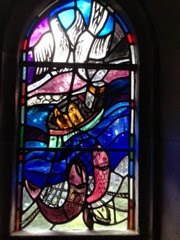
Saturday, 6 September 2014

Covenant of love


Genesis 6:11-22
Now the earth was corrupt in God’s sight, and the earth was filled with violence. And God saw that the earth was corrupt; for all flesh had corrupted its ways upon the earth. And God said to Noah, “I have determined to make an end of all flesh, for the earth is filled with violence because of them; now I am going to destroy them along with the earth. Make yourself an ark of cypress wood; make rooms in the ark, and cover it inside and out with pitch. This is how you are to make it: the length of the ark three hundred cubits, its width fifty cubits, and its height thirty cubits. Make a roof for the ark, and finish it to a cubit above; and put the door of the ark in its side; make it with lower, second, and third decks. For my part, I am going to bring a flood of waters on the earth, to destroy from under heaven all flesh in which is the breath of life; everything that is on the earth shall die. But I will establish my covenant with you; and you shall come into the ark, you, your sons, your wife, and your sons’ wives with you. And of every living thing, of all flesh, you shall bring two of every kind into the ark, to keep them alive with you; they shall be male and female. Of the birds according to their kinds, and of the animals according to their kinds, of every creeping thing of the ground according to its kind, two of every kind shall come in to you, to keep them alive. Also take with you every kind of food that is eaten, and store it up; and it shall serve as food for you and for them.” Noah did this; he did all that God commanded him.
Genesis 9:11-17
I establish my covenant with you, that never again shall all flesh be cut off by the waters of a flood, and never again shall there be a flood to destroy the earth.” God said, “This is the sign of the covenant that I make between me and you and every living creature that is with you, for all future generations: I have set my bow in the clouds, and it shall be a sign of the covenant between me and the earth. When I bring clouds over the earth and the bow is seen in the clouds, I will remember my covenant that is between me and you and every living creature of all flesh; and the waters shall never again become a flood to destroy all flesh. When the bow is in the clouds, I will see it and remember the everlasting covenant between God and every living creature of all flesh that is on the earth.” God said to Noah, “This is the sign of the covenant that I have established between me and all flesh that is on the earth.”


The story of Noah and the ark has been done to death, hasn't it?
We teach it to children from earliest days.
Nursery toy boxes will almost certainly have a Noah's ark play set buried somewhere in there.
And the rainbow is sung about in all tempos and genres.
Big boats, animals and rainbows - all make a pretty story.
NOT!
Look again.
God, having created a beautiful world, sees how evil and corruption have affected creation.
And decides, like a child with an etch a sketch board (remember those?) to erase what has become and start over again.
Sounds like a pretty easy thing for God to do.
But then God notices Noah and decides that he is OK - and his family.
So he devises a rescue plan for Noah, along with the animals that inhabit the earth.
An ark that will keep them afloat while the rest of creation and humankind is destroyed by floods.
And so, the first question that this story raises for me is:
What kind of God creates human beings to make choices and then destroys them when they make the wrong choices?
What kind of God simply gives up on creation?
And then, when the earth is destroyed, when folk have been swept away by floods or have led their loved ones to higher and higher ground and been forced to watch others drowning before they, too, have no place else to go and succumb to a watery death, what kind of God chooses the symbol of a rainbow as a reminder of the wrath of God and a promise that this angry, vengeful God, will not destroy the world in this way again?

I establish my covenant with you, that never again shall all flesh be cut off by the waters of a flood, and never again shall there be a flood to destroy the earth.” God said, “This is the sign of the covenant that I make between me and you and every living creature that is with you, for all future generations: I have set my bow in the clouds, and it shall be a sign of the covenant between me and the earth. 

Who would want a symbol of Covenant with such a God?
Somehow, beyond Sunday School, this story is a horror story.
What are we to make of this God, portrayed in Hebrew Scripture as a God of such contrasts?
Angry, loving, vengeful, remorseful?
Over the next few weeks, we will be exploring the nature of a Covenant God.
A God who makes promises.
A God who offers relationship.
We'll look at the nature and terms of that relationship.
And what those promises might mean for creation and for the people of God today.
We'll also look at the burdens and responsibilities, the hopes and the aspirations that living in Covenant with God might bring to us.
Perhaps one of the first themes we might explore is that establishing covenant with God involves a journey.
A journey, often portrayed in Hebrew Scripture as a physical journey.
God tended to call people to leave all that was familiar and journey to a new place.
And, in this story of the Ark, God calls Noah to leave behind all he has known, to journey with his family to a place inconceivable and unrecognisable.
And it is often on the journey, not at their destination, but on the journey that God's people learn most about themselves and about the God who calls them out of all that is familiar and into relationship.
Fred Beuchner, writes this of that journey in the ark:
".., just about everything imaginable is aboard, the clean and the unclean both. They are all piled in together helter-skelter, the predators and the prey, the wild and the tame, the sleek and beautiful ones and the ones that are ugly as sin. There are sly young foxes and impossible old cows. There are the catty and the piggish and the peacock-proud. There are hawks and there are doves. Some are wise as owls, some silly as geese; some meek as lambs and others fire-breathing dragons. There are times when they all cackle and grunt and roar and sing together, and there are times when you could hear a pin drop. Most of them have no clear idea just where they’re supposed to be heading or how they’re supposed to get there or what they’ll find if and when they finally do, but they figure the people in charge must know and in the meanwhile sit back on their haunches and try to enjoy the ride.”
(from Whistling in the Dark)

Wow! What a picture. Everything imaginable aboard, all piled in helter-skelter. No clear idea how to get there or what they'll find when they arrive, figuring the people in charge must know...
Is it just me, or does that seem like a description of our Scottish Referendum?
Except I'm not sure that we have that much faith in the people in charge!!!

But there is a huge element, as we'll discover in the weeks ahead, as we navigate these texts on Covenant and as we navigate a post Referendum Scotland, that, often, we're skiddling about not sure where we're going, but travelling in hope, sometimes with a healthy dose of scepticism,doing our best to enjoy the ride and the community along the way.
That seems to me an apt description of the church in the world today.
Comprised of people raising mighty big questions with the God who is in charge, but settling to the journey, building community where we can, and living in hope of relationship that is not destructive but builds up and sustains. Of course it will be a bumpy ride. Trusting that the God of floods and rainbows will lead us out of what we know to what we will be. Perhaps we won't recognise the landscape at journey's end. Perhaps we won't recognise ourselves, changed as we must surely be by the journey. But we put our hope in God who makes a covenant with us, a covenant shot through with love.
Thanks be to God.

Sunday, 24 August 2014

Living it up


Matthew 16:13-20
Peter Confesses Jesus as the Christ
Now when Jesus came into the district of Caesarea Philippi, he asked his disciples, “Who do people say that the Son of Man is?” And they said, “Some say John the Baptist, others say Elijah, and others Jeremiah or one of the prophets.” He said to them, “But who do you say that I am?” Simon Peter replied, “You are the Christ, the Son of the living God.” And Jesus answered him, “Blessed are you, Simon Bar-Jonah! For flesh and blood has not revealed this to you, but my Father who is in heaven. And I tell you, you are Peter, and on this rock I will build my church, and the gates of hell shall not prevail against it. I will give you the keys of the kingdom of heaven, and whatever you bind on earth shall be bound in heaven, and whatever you loose on earth shall be loosed in heaven.” Then he strictly charged the disciples to tell no one that he was the Christ.

I'm sure many of you have heard today's gospel passage read countless times. And many times you'll have been asked to consider: Who do you say Jesus is?
One of the things I've been reflecting on this week is - how much easier it would be if we didn't see Jesus as the Christ, the son of the living God.
Somehow, Jesus being like John the Baptist or one of the prophets takes the pressure off us.
Because that Jesus is more like us. Prone to mishap. Full of mistakes. Not perfect.
And that kind of Jesus is easier to live up to.
It's once we see Jesus as the Son of God, that we run into trouble.
Because that allows us no leeway.
That Jesus, the Son of God, demands much more of us.
We've been discovering, as we move through Matthews gospel, how Jesus reveals the nature of God.
A God who is compassionate.
A God who weeps when people suffer, through depression, through injustice, through war and violence.
A God whose heart is broken in the pain of the world.
Proclaiming Jesus the Son of God demands that we, too, try to be like the one who reveals God to us.
Proclaiming Jesus as the Son of God demands that we are compassionate, that we hurt when others hurt.
Proclaiming Jesus as the Son of God demands that we follow Jesus' example, we push boundaries, upset those in authority and stop at nothing until justice prevails and until peace becomes a reality.
No wonder we are slow to proclaim Jesus as the Son of God.
Because that proclamation changes our lives.
That proclamation is not just about who we say Jesus is.
It is also about who we are prepared to be.
That is why Jesus put Peter on the spot.
Went from "Who do people say I am?" to "Who do you say I am?"
Jesus wanted to know if Peter was ready to step up, ready to be handed the keys of the Kingdom.
Peter's response demonstrated that he was ready.
"You are the Christ, the son of the living God."
Jesus was satisfied by this response that Peter got it - that not only did he know who Jesus was - but that he knew what it meant to be a follower of Christ, the Son of God.
We know that Peter didn't always get it right.
Far from it.
But, often, the reason he fell short was because he was always prepared to step up.
Peter doesn't hang back- in anything.
And so we read in the gospels of his failures as well as his triumphs.
And anyone who is willing to try to serve God will have times when they don't get it quite right.
But God honours intentions - those who try rather than those who hang back for fear of getting it wrong.
Our response to Jesus question: "Who do you say I am?" is a call to action.
It is not enough to profess Christ.
Our actions must mirror our words.

But the gospel is not a call this morning for is to feel bad about our response to Jesus' question.
It is not a call for us to focus on all the times we've managed to get it wrong or failed to witness and serve Christ as we should.
Rather, it's a call to remind ourselves why we do what we do.
Why, in our everyday, we do certain things in certain ways.
Why we are so affected by the plight of others.
Even why we despair at the state of our world.
And why we hope and believe that things can be different.
Because we know that Jesus is the Son of the living God, we are moved to believe in and to work for peaceful and loving communities here and throughout our world.
We are moved to pray for and believe in justice for all God"s people - and to do whatever we can to make that a reality.
Jesus, the Son of the living God demands that, even and especially in the darkness of our world, where light seems scarce and where hope is fragile, that we who confess Christ as Lord keep hope alive and keep on working for peace and for healing for all God's children.
You are the Christ,the Son of the living God.
A statement of faith and a call to action.
Foundation stones and building blocks in the kingdom of God.
I challenge all of us this week to think deeper about our profession of faith.
Whether that profession be, as in baptism, I believe in one God, Father, son and Holy Spirit, or whether it be You are the Christ, the Son of the living God.
I challenge us all to think about those professions of faith and how they affect how we see the world today.
Through the lens of hope.
Because as soon as we profess faith, we are also embracing hope.
The hope that all the darkness and evil that we see in our world, the hope that all the injustice and suffering can be overcome by a God who works through us to bring love into the world.
Our profession of faith opens us even more to grieve for all that is wrong in the world but, in our grief, to have hope that the power of God's love will have the last word.
And that, in the meantime, you and I can make a difference every day by living in that love, not just proclaiming faith but living it out.
We, who profess faith here are compelled and empowered to live out that faith in the world we serve every day.
Thanks be to God.

Saturday, 2 August 2014

An abundance of miracles

Matthew 14:13-21
Jesus Feeds the Five Thousand 
Now when Jesus heard this, he withdrew from there in a boat to a desolate place by himself. But when the crowds heard it, they followed him on foot from the towns. When he went ashore he saw a great crowd, and he had compassion on them and healed their sick. Now when it was evening, the disciples came to him and said, “This is a desolate place, and the day is now over; send the crowds away to go into the villages and buy food for themselves.” But Jesus said, “They need not go away; you give them something to eat.” They said to him, “We have only five loaves here and two fish.” And he said, “Bring them here to me.” Then he ordered the crowds to sit down on the grass, and taking the five loaves and the two fish, he looked up to heaven and said a blessing. Then he broke the loaves and gave them to the disciples, and the disciples gave them to the crowds. And they all ate and were satisfied. And they took up twelve baskets full of the broken pieces left over. And those who ate were about five thousand men, besides women and children.

Our gospel began "Now when Jesus heard this, he withdrew from there in a boat to a desolate place by himself."
What Jesus heard was that his cousin, John the Baptist had been killed. 
Killed by Herod.
You may remember the story: Herod had imprisoned John the Baptist because John had been calling into question the propriety of Herod being with his brother's wife. Although he had John the Baptist imprisoned, Herod was frightened to kill him because he was afraid of how folk would react - they saw John as a prophet.
But, on his wife's birthday, Herod enticed her daughter to dance by promising her she could have any favour she wanted. And the daughter, Salome, at the urging of her mother, requested the head of John the Baptist on a plate.
A gruesome tale.
So John the Baptist met his end.
This was the news that Jesus had just received.
That his cousin, the man who had prepared the way for him, the man who had led him to the waters of baptism had been murdered.
Jesus response was to withdraw - to seek some space in which to mourn his loss.
And so he took a boat out on the water, seeking some quiet, to be alone with his grief.
I can't think of a better place to get away than taking a boat to a desolate place.
That may not be your idea of retreat.
Indeed, the very idea of retreating might be alien for you.
But, when I want space to think, and, especially, when I want space to mourn, water does it every time.
Be it still water or roaring water, I can find calm and healing by streams, rivers or oceans.
So Jesus, needing space to mourn, takes a boat and goes off to a desolate place.
Clearly not desolate enough!
Because crowds of people manage to follow him, not on the water, but on foot.
So that, by the time he came ashore, there was a great crowd of people waiting on him.
No gentle re-entry for Jesus!
Straight back into the fray!
I'm sure many of you know that feeling all too well.
I know I do!
But Jesus, when he saw the crowds on the shore waiting to greet him, was filled with compassion.
And right away, he began to minister to them, healing the sick. 
As the people hung around, soaking up that ethos of care and compassion, the day wore on.
The disciples wanted to bring what must have been a long and tiring day for Jesus to a close as evening came.
But that was not to be.
Jesus compassion was far from exhausted.
And he had something special in store, not just for the crowd but for his disciples too.
The author of Matthews gospel is keen, throughout the gospel, to point out to us the nature of God as mirrored in the actions of a Jesus.
In the story of the feeding of the 5000, we are confronted with the overwhelming compassionate nature of God.
A God who is affected by loss, who mourns, but who, even in the midst of grief reaches out - who sees the need of a hungry crowd and reaches out to heal and to feed.
But, in this story, we are also confronted by an enabling God.
A God who equips ordinary people to respond to need and to feed those around them.
When the disciples ask Jesus to send the crowd away to find food, Jesus counters their demands with the challenge: You feed them.
Now when it was evening, the disciples came to him and said, “This is a desolate place, and the day is now over; send the crowds away to go into the villages and buy food for themselves.” But Jesus said, “They need not go away; you give them something to eat.”
Of course the Son of God could have done that himself.
But the nature of God is to enable us to care for one another.
We, who pray for miracles in our daily lives today are often charged and empowered to bring those miracles to fruition.
As you know, earlier this year, I was lucky enough to spend time in New Orleans with some awesome colleagues. 
There are many special foods in New Orleans, but one of my favourites was the po'boy.
This took many forms but was basically a baguette or sub sandwich filled with all sorts of loveliness - a fried shrimp po'boy with Cajun spices was probably my favourite.
But the origin of the po'boy intrigued me.
Legend has it that two brothers who went to New Orleans, working on the street cars before opening a coffee stand in the famous French Market, decided to support their former colleagues during an industrial dispute just before the Great Depression.
The street car workers, striking for fairer conditions as were other transit workers through the States, were fed bread and whatever fillings were to hand by these brothers allowing them to hold out for fairer working conditions.
The sandwiches were known as poor boy's sandwiches - and became the po'boys that are an inventive and varied speciality today.
Sadly, the Great Depression resulted in the fight being lost but the "poor boys" continued to be cared for.
Ordinary people working miracles, reaching out in compassion to feed one another. 
Whatever else is going on in the gospel passage we read today, a passage that has so much in it when we stop to examine it again, a passage that reveals something new for us every time.
Whatever else is going on, let's be mindful today of the nature of God that we find reflected there.
A God moved with compassion.
A God who enables ordinary people to respond and to effect change.
Our call as disciples today, is to reflect those facets of God to the world we serve.
To respond with compassion.
To reach out with the gifts that we have, feeding one another, enabling one another, effecting miracles in our everyday.

And, just before we leave the story today, what about the leftovers?
Not only were people fed that day, but there was an abundance.
An abundance that Jesus had folk carefully gather up.
Isn't that the essence of grace.
That when we share, there is always more than enough.
Grace knows no limits.
It grows in the giving - both in what is shared and in the giver:

The bits left over,
what of those?
Pieces left strewn around,
no longer required.
A plethora
of scraps,
yet Christ leaves none discarded
but calls for all to be gathered in,
saved and treasured.
Baskets filled with an extravagance-
excess cherished.
Symbolism
that can only be imagined.
A hungry crowd,
a boy's packed lunch,
a great big picnic.
People fed
and still enough
to go on sharing
the blessing, 
 abundance,
and grace of God.

Thanks be to God
Amen

(The image is of the "tea van" meeting pilgrims on Iona with a welcome cuppa)

Friday, 25 July 2014

Groans and sighs

Romans 8:26-39
Likewise the Spirit helps us in our weakness. For we do not know what to pray for as we ought, but the Spirit himself intercedes for us with groanings too deep for words. And he who searches hearts knows what is the mind of the Spirit, because the Spirit intercedes for the saints according to the will of God. And we know that for those who love God all things work together for good, for those who are called according to his purpose. For those whom he foreknew he also predestined to be conformed to the image of his Son, in order that he might be the firstborn among many brothers. And those whom he predestined he also called, and those whom he called he also justified, and those whom he justified he also glorified. God's Everlasting Love What then shall we say to these things? If God is for us, who can be against us? He who did not spare his own Son but gave him up for us all, how will he not also with him graciously give us all things? Who shall bring any charge against God's elect? It is God who justifies. Who is to condemn? Christ Jesus is the one who died—more than that, who was raised—who is at the right hand of God, who indeed is interceding for us. Who shall separate us from the love of Christ? Shall tribulation, or distress, or persecution, or famine, or nakedness, or danger, or sword? As it is written, “For your sake we are being killed all the day long;we are regarded as sheep to be slaughtered.” No, in all these things we are more than conquerors through him who loved us. For I am sure that neither death nor life, nor angels nor rulers, nor things present nor things to come, nor powers, nor height nor depth, nor anything else in all creation, will be able to separate us from the love of God in Christ Jesus our Lord.

The Spirit helps us in our weakness. For we do not know what to pray for as we ought, but the Spirit intercedes for us with groanings too deep for words.

I rarely watch television. Even on the odd nights I'm at home, I'd rather be doing other things. So most of my news comes via the internet and social media. And I think, now, more than ever before, that must be a good thing. To read about all the awful things happening across the globe, with perhaps the odd captioned picture is hard enough, without seeing those events - and their aftermath - in glorious, or inglorious technicolour.
I'm sure you'll agree that, for those of us of a praying persuasion, it's hard to know where to start, unless it is with a litany of grief.
For murdered children
For bereaved parents
For displaced and divided families
For discarded and broken lives
For planes shot down in acts of terrorism
Or falling from the skies through technical failure or mystery
For people denied freedom
and basic human rights
For those persecuted by oppressive governments
and religious regimes
For those who see violence
as a way to peace
For those who meet conflict
with destructive force.

We need the Spirit to intercede for us. To take our jumbled thoughts and emotions and our lack of understanding, to take our grief and sorrow that's beyond words and set up the line of communication between our hearts and the heart of God. The Spirit allows that heart connection, a connection unspoiled by the things we do not know or fail to understand, unsullied by our inability to feel the depth of pain and sorrow contained in news headlines and in stories of human suffering that have long since been forgotten or never even been told. The Spirit bridges the gap between our hearts and the heart of God, not only giving us a way to connect with what is human and divine but also holding our hearts and preventing them from breaking with the weight of sorrow.
Prayer that makes a difference in our world today is not a beautifully composed and assembled form of words.
It's a sigh that connects right to the heart of God.
A sigh, that in its depth conveys the hope and the promise contained in the rest of this passage from Romans 8.

The promise that we read:
For those who love God all things work together for good, for those who are called according to God's purpose.

I've often heard offered this promise offered in times of trial.
In fact, at times, I too have used these words to comfort others.
Words that seem like such a bold and improbable promise in the light of the world's suffering today.
What can possibly be the purpose of God in Israel or Palestine, in Algeria or Afghanistan, in Malaysia or the Netherlands? Or all those other places that flit in and out of our news, so quickly replaced by the next horror story of human degradation and deprivation?
The God in whom I believe does not allow creation to suffer just so that some divine purpose can be realised.
But this God, present where there is suffering of any kind, is able to conceive of a new way, a different world, a world in which suffering is redeemed.
A God who holds out hope and promise for a suffering world.
A God who knows and who is even now fashioning a world beyond our imagining, a world that connects with those Spirit groans, built on the very heart of a God who is love.
That is the promise.
And that promise is sustained by this hope:
For I am sure that neither death nor life, nor angels nor rulers, nor things present nor things to come, nor powers, nor height nor depth, nor anything else in all creation, will be able to separate us from the love of God in Christ Jesus our Lord.
Nothing can separate us from the love of God.
It is to that hope that we cling.
So, even when we despair at all that is happening in the world, when we see no justice, no peace, still we can see the love of God at work.
In all the myriad ways that folk reach out to help one another, to spread the love in every circumstance.
Our daily news bulletins, however we receive them, often catapult us into a pit of despair or, even worse, indifference, because we think that we cannot change the suffering of the world.
And we cannot find the words even to pray.

But - Ours is a call not to eloquence.
But to groans of prayer.
A call to connect with the heart of God.
A call to claim the promise of God.
And a call to embrace the hope that NOTHING can separate us from the love of God.
And, responding to that call, we will know God's purposes fulfilled for the good of all creation.
Thanks be to God.

Saturday, 19 July 2014

Growing together


Matthew 13:24-30
The Parable of the Weeds 
He put another parable before them, saying, “The kingdom of heaven may be compared to a man who sowed good seed in his field, but while his men were sleeping, his enemy came and sowed weeds among the wheat and went away. So when the plants came up and bore grain, then the weeds appeared also. And the servants of the master of the house came and said to him, ‘Master, did you not sow good seed in your field? How then does it have weeds?’ He said to them, ‘An enemy has done this.’ So the servants said to him, ‘Then do you want us to go and gather them?’ But he said, No, lest in gathering the weeds you root up the wheat along with them. Let both grow together until the harvest, and at harvest time I will tell the reapers, Gather the weeds first and bind them in bundles to be burned, but gather the wheat into my barn.’”

Who are we to judge
who’s in and who’s out,
who fits and who doesn't?
How can we tell 
what belongs and what doesn't?
The God of the harvest
encourages us simply
to do what we can,
to grow together,
to influence the other,
knowing that in the end
no matter how it looks on the outside,
how much it may seem like
we all fit together,
those who deny life to others
will not survive
but will be removed,
allowing space to grow
the kingdom of God.

Saturday, 12 July 2014

It's not about us?


Matthew 13:1-9; 18-23
The Parable of the Sower
 That same day Jesus went out of the house and sat beside the sea. Such great crowds gathered around him that he got into a boat and sat there, while the whole crowd stood on the beach. And he told them many things in parables, saying:“Listen! A sower went out to sow. And as he sowed, some seeds fell on the path, and the birds came and ate them up. Other seeds fell on rocky ground, where they did not have much soil, and they sprang up quickly, since they had no depth of soil. But when the sun rose, they were scorched; and since they had no root, they withered away. Other seeds fell among thorns, and the thorns grew up and choked them. Other seeds fell on good soil and brought forth grain, some a hundredfold, some sixty, some thirty. Let anyone with ears listen!”
The Purpose of the Parables
 
The Parable of the Sower Explained
 “Hear then the parable of the sower. When anyone hears the word of the kingdom and does not understand it, the evil one comes and snatches away what is sown in the heart; this is what was sown on the path. As for what was sown on rocky ground, this is the one who hears the word and immediately receives it with joy; yet such a person has no root, but endures only for a while, and when trouble or persecution arises on account of the word, that person immediately falls away. As for what was sown among thorns, this is the one who hears the word, but the cares of the world and the lure of wealth choke the word, and it yields nothing. But as for what was sown on good soil, this is the one who hears the word and understands it, who indeed bears fruit and yields, in one case a hundredfold, in another sixty, and in another thirty.”

The parable we read this morning - of the sower and the seed is,perhaps, one that is familiar.
A parable that we've heard a few times and think that we know what it means.
After telling this story, Jesus said: "Let anyone with ears, listen!"
I wonder what we hear when we listen to this story today? 
And I suspect that many of us hear, in this story words of judgment. 
We hear Jesus telling us that we don't measure up.
We see ourselves as the wrong type of soil, like those in Jesus' story.
Some of us might think of ourselves as the path on which the seed landed, a hard ground, trampled on, walked over. Any fleeting joy is snatched up and taken away, like the seed snatched up by the birds from the path.
Or maybe you feel like that rocky ground.
You want to believe but there is too much that distracts you,that causes you to question.
The state of our world, the suffering some people have to endure, the injustice,the inequality, the lack of evidence of a God of love.
You started out believing but too many weeds have sprung up to squeeze the life out of that faith you once had.
Or what about those thorns.
Do you feel as though your faith is doomed before it begins, thwarted by the pain you endure just to get out of bed every day? Pain that is physical or emotional,maybe even both - chronic illness, the ache for a loved one...
So you hear this parable as a parable of judgment but you look around this morning and see folk whom you gauge to be the good soil of which Jesus speaks - folk who have got it together, who know the drill, who understand faith much better than you do and so are providing that good soil that measures up.
This morning, I want to read this parable to you again.
And I want you to listen.
I'm going to read it from The Message version of the Bible and I invite you to listen, really listen.
Listen without your judgment hat on just for a moment:
Mat 13:1-9
A Harvest Story ​ 
At about that same time Jesus left the house and sat on the beach. In no time at all a crowd gathered along the shoreline, forcing him to get into a boat. Using the boat as a pulpit, he addressed his congregation, telling stories. "What do you make of this? A farmer planted seed. As he scattered the seed, some of it fell on the road, and birds ate it. Some fell in the gravel; it sprouted quickly but didn't put down roots, so when the sun came up it withered just as quickly. Some fell in the weeds; as it came up, it was strangled by the weeds. Some fell on good earth, and produced a harvest beyond his wildest dreams. "Are you listening to this? Really listening?" 

The Parable of the Sower Explained
 “Hear then the parable of the sower. When anyone hears the word of the kingdom and does not understand it, the evil one comes and snatches away what is sown in the heart; this is what was sown on the path. As for what was sown on rocky ground, this is the one who hears the word and immediately receives it with joy; yet such a person has no root, but endures only for a while, and when trouble or persecution arises on account of the word, that person immediately falls away. As for what was sown among thorns, this is the one who hears the word, but the cares of the world and the lure of wealth choke the word, and it yields nothing. But as for what was sown on good soil, this is the one who hears the word and understands it, who indeed bears fruit and yields, in one case a hundredfold, in another sixty, and in another thirty.”

What if this story Jesus told was not so much about what type of soil we are.
Not so much about how we don't measure up.
What is this story was more about the sower- the one who took seed and just threw it anywhere, the one who didn't carefully dig a hole and place in it a seed but who scooped up a handful of seed and threw it willy nilly, so that it landed anywhere and everywhere.
Focussing on the sower of the seed, allows us to see this parable completely differently.
To be as scandalised by this parable as were the disciples and all the folk who heard it.
For the sower was indiscriminate.
The sower allowed the seed to fall anywhere, the sower took all kinds of chances.
The folk around Jesus did not see that kind of extravagance in the farming practices around them or in the purposes of The God they worshipped.
Gods love was meant for a chosen few.
It was inconceivable that Jesus was suggesting that seed could be scattered far and wide, without limit, without boundary.
And still today, we have trouble grasping that.
We want to limit the bounds of  Gods love.
We want to place some people and some places out of reach, beyond the pale.
God never deems any cause not worthy of effort.
God never gives up on potential.
If we look at this parable and think of all the different types of soil.
If we think about when and where we have been a particular type of soil, most of us have been all of these at sometime, perhaps all at once.
If we think about the types of soil, of course we won't measure up.
But if we look instead at the sower as God.
A God who doesn't reserve love for just the right type of soil.
A God who keeps on throwing love in all directions, never giving up hope, always offering more love.
If we look at this example that God the sower sets us, the parable takes on a whole different meaning.
It's a call to us to be extravagant.To keep on throwing out seeds. To keep on hoping that some of them will find rich soil in which to grow.
But, even when we don't see results, this parable is a call for us to keep on making the effort - and leave the rest to God.
It may not be good economics.
But it is faithful discipleship.
Continuing to sow even when the harvest seems lost - it's to that kind of faithfulness that our extravagant God calls us.
So,let's not get all tied up in trying to work out which kind of soil we are.
Let's respond, instead, to God's call to keep on throwing out seeds of love, never giving up as God never gives up.

The gospel reading this morning missed out a chunk in the middle of the passage, the bit where Jesus explains why he uses parables.
I'd like to share that with you this morning - those missed out verses, 10-17:

Why Tell Stories? (10-17)
The disciples came up and asked, "Why do you tell stories?" He replied, "You've been given insight into God's kingdom. You know how it works. Not everybody has this gift, this insight; it hasn't been given to them. Whenever someone has a ready heart for this, the insights and understandings flow freely. But if there is no readiness, any trace of receptivity soon disappears. That's why I tell stories: to create readiness, to nudge the people toward receptive insight. In their present state they can stare till doomsday and not see it, listen till they're blue in the face and not get it. I don't want Isaiah's forecast repeated all over again: Your ears are open but you don't hear a thing. Your eyes are awake but you don't see a thing. The people are blockheads! They stick their fingers in their ears so they won't have to listen; They screw their eyes shut so they won't have to look, so they won't have to deal with me face-to-face and let me heal them. "But you have God-blessed eyes—eyes that see! And God-blessed ears—ears that hear! A lot of people, prophets and humble believers among them, would have given anything to see what you are seeing, to hear what you are hearing, but never had the chance.

Today, we have God-blessed eyes and God-blessed ears.
Let's be ready to use them.
Let's be ready to be nudged by God into action.
Sowing seeds in seemingly hopeless situations.
Living in extravagant love with a God who never gives up.
For the glory of God.
Thanks be to God.


Wednesday, 9 July 2014

Extravagance

Matthew 13:18-23
The Parable of the Sower Explained
 “Hear then the parable of the sower. When anyone hears the word of the kingdom and does not understand it, the evil one comes and snatches away what is sown in the heart; this is what was sown on the path. As for what was sown on rocky ground, this is the one who hears the word and immediately receives it with joy; yet such a person has no root, but endures only for a while, and when trouble or persecution arises on account of the word, that person immediately falls away. As for what was sown among thorns, this is the one who hears the word, but the cares of the world and the lure of wealth choke the word, and it yields nothing. But as for what was sown on good soil, this is the one who hears the word and understands it, who indeed bears fruit and yields, in one case a hundredfold, in another sixty, and in another thirty.”

How awful
How obscenely extravagant
How indiscriminate of God
To throw open the gates of the kingdom
So that anyone might find a way in
No standards
No safeguards
But a generosity
That is sure to be abused
And just as scandalous today
As was this message
To those who listened to Jesus
Still there are those
Who do not want to believe
Who want to rewrite
The story of God’s unconditional welcome
Who want to maintain standards
And conditions
And limit the sphere
Of the impossible kingdom of God
Thankfully the God of the Universe
Knows no bounds
And cannot be subdued
But carries on regardless
Sowing and reaping
Shuffling and  shoogling, 
Making space for all
Throwing wide the doors
And gathering us in.